
Year 6 Maths Worksheets PDF: A Comprehensive Guide
Year 6 Maths Worksheets, available as PDFs, offer focused practice across crucial topics. These resources support the National Curriculum, aiding students in mastering key mathematical concepts.
Year 6 Maths Worksheets represent a pivotal stage in a child’s mathematical journey, bridging the gap between foundational skills and the more complex concepts encountered in secondary school. These worksheets, frequently available in convenient PDF format, are designed to reinforce classroom learning and provide targeted practice in essential areas. They cater to a diverse range of learning styles and abilities, offering a structured approach to skill development.
The core purpose of these resources is to solidify understanding of key topics, including number operations, fractions, decimals, algebra, data handling, and problem-solving. A well-designed worksheet isn’t simply a collection of problems; it’s a carefully curated learning tool. They often incorporate varied question types – from straightforward calculations to more challenging word problems – to encourage critical thinking and application of knowledge.
Furthermore, the accessibility of PDF worksheets is a significant advantage. They can be easily downloaded, printed, and used both in the classroom and at home, fostering a collaborative learning environment between teachers, parents, and students. These worksheets are invaluable for homework assignments, revision exercises, and formative assessments, ultimately contributing to a student’s overall mathematical proficiency.
Why Use PDF Worksheets?
PDF worksheets offer a multitude of benefits for both educators and students when focusing on Year 6 Maths. Their primary advantage lies in their universal compatibility – they can be opened and printed on virtually any device without formatting issues. This ensures consistent presentation, regardless of the user’s operating system or software.
Beyond compatibility, PDFs are easily downloadable and storable, creating a readily accessible library of resources. This eliminates the need for physical storage space and allows for quick retrieval of specific worksheets. They are also ideal for remote learning scenarios, enabling seamless distribution to students learning from home.
Furthermore, PDFs are often designed to be printable, allowing students to practice traditional pen-and-paper methods, which are crucial for developing fine motor skills and reinforcing understanding. The fixed layout prevents accidental alterations, ensuring students engage with the intended content. Finally, the cost-effectiveness of downloadable PDFs makes them an accessible option for schools and families alike, promoting equitable access to quality educational materials.
Core Topics Covered in Year 6 Maths
Year 6 Maths worksheets comprehensively cover a wide range of topics, building upon prior knowledge and preparing students for secondary school. A foundational area is Numbers Up To 100 & Beyond, including place value, ordering, and comparing larger numbers. Integers and Rational Numbers are introduced, encompassing positive and negative numbers, and the basics of fractions and decimals.
Arithmetic and Number Theory Worksheets focus on mastering the four operations – Addition and Subtraction, and Multiplication and Division – with increasingly complex problems. Decimals Worksheets delve into decimal operations, rounding, and conversions. Fractions Worksheets cover equivalent fractions, simplifying, adding, subtracting, multiplying, and dividing.
Beyond number work, Algebraic Expressions & Factoring are introduced at a basic level, laying the groundwork for future algebraic concepts. Data and Graphing Worksheets develop skills in interpreting and creating various graphs and charts. Financial Literacy is also incorporated, teaching budgeting and problem-solving. Finally, Problem Solving & Word Problems are integrated throughout, encouraging critical thinking and application of learned skills.
Numbers Up To 100 & Beyond
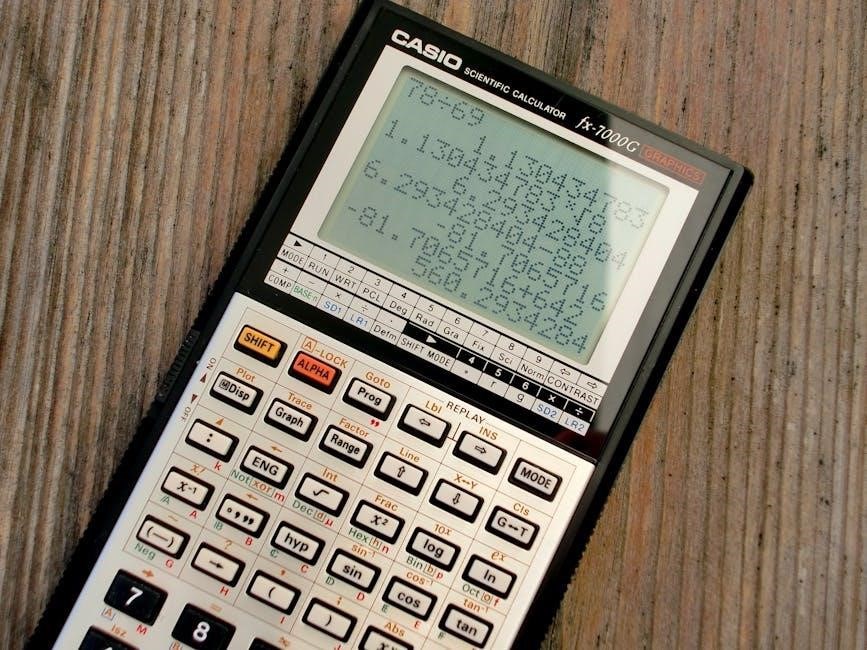
Year 6 Maths worksheets dedicated to ‘Numbers Up To 100 & Beyond’ solidify understanding of place value, extending beyond simple two-digit numbers. Students practice arranging numbers in order, both ascending and descending, and comparing their values using greater than, less than, or equal to symbols. These worksheets often include exercises focused on identifying the value of digits in different place value columns – units, tens, hundreds, thousands, and beyond.
A key component involves working with larger numbers, performing calculations like addition and subtraction with numbers extending into the thousands and even ten-thousands. Worksheets also reinforce the concept of rounding numbers to the nearest 10, 100, or 1000, developing estimation skills. Furthermore, students encounter exercises involving column addition and subtraction, strengthening their procedural fluency.
These resources build a strong numerical foundation, essential for tackling more complex mathematical concepts later on. Mastering these skills is crucial for success in all areas of mathematics, providing a solid base for future learning.
Integers and Rational Numbers
Year 6 Maths worksheets focusing on ‘Integers and Rational Numbers’ introduce students to the concept of numbers extending beyond zero, including both positive and negative values. These worksheets help students understand the number line, plotting both positive and negative integers accurately. A core skill developed is performing calculations with positive and negative numbers, initially focusing on addition and subtraction.
Rational numbers, including fractions and decimals, are also explored. Worksheets provide practice in identifying, comparing, and ordering fractions, as well as converting between fractions, decimals, and percentages. Students learn to simplify fractions to their lowest terms and find equivalent fractions. Exercises often involve real-world scenarios to demonstrate the practical application of these concepts.
Understanding integers and rational numbers is fundamental for progressing to more advanced algebraic concepts. These worksheets build a strong foundation for future mathematical studies, fostering a deeper understanding of numerical relationships.
Arithmetic and Number Theory Worksheets
Year 6 Maths worksheets dedicated to ‘Arithmetic and Number Theory’ solidify foundational calculation skills and introduce key number properties. These resources heavily emphasize fluency in the four basic operations – addition, subtraction, multiplication, and division – using increasingly complex numbers. Worksheets often incorporate column addition and subtraction, alongside practice with grid multiplication, to enhance procedural understanding.
Number theory concepts are introduced, including identifying prime numbers, composite numbers, and factors. Students practice finding common factors and multiples, laying the groundwork for understanding fractions and simplifying expressions. Worksheets also cover divisibility rules, enabling students to quickly determine if a number is divisible by 2, 3, 5, 6, 9, and 10.
These worksheets aren’t just about rote memorization; they aim to develop a conceptual understanding of how numbers work and relate to each other, building a strong base for more advanced mathematical topics.
Addition and Subtraction Worksheets
Year 6 Maths worksheets focusing on addition and subtraction build upon prior learning, progressing to more complex problems involving larger numbers and varied formats. These resources move beyond basic calculations, incorporating multi-step problems requiring students to apply their skills in real-world contexts. A significant emphasis is placed on mastering column addition and subtraction, ensuring accuracy and efficiency with multi-digit numbers;

Worksheets often include problems with missing numbers, encouraging students to use inverse operations to check their answers and develop problem-solving strategies. Practice extends to adding and subtracting decimals, reinforcing place value understanding. Furthermore, students encounter word problems that require them to identify the appropriate operation – addition or subtraction – based on the scenario.
These worksheets aim to solidify fluency and accuracy, preparing students for more advanced arithmetic operations and fostering a strong foundation in numerical reasoning.
Multiplication and Division Worksheets
Year 6 Maths worksheets dedicated to multiplication and division expand upon foundational skills, introducing more challenging calculations and problem-solving scenarios. Students refine their understanding of times tables, progressing to multiplying larger numbers, including those with multiple digits. Grid multiplication is frequently featured, providing a visual method for tackling complex multiplication problems and reinforcing place value.
Division practice encompasses both short division and long division, building fluency and accuracy with different methods. Worksheets often include problems with remainders, prompting students to interpret and understand what the remainder represents in context. Emphasis is placed on understanding the relationship between multiplication and division as inverse operations.
Real-world word problems are integral, requiring students to determine whether multiplication or division is the appropriate operation to solve the given scenario. These resources aim to develop both procedural fluency and conceptual understanding, preparing students for more advanced mathematical concepts.
Decimals Worksheets ⸺ Grade 6
Grade 6 Decimals Worksheets provide targeted practice in understanding and manipulating decimal numbers. These resources build upon prior knowledge of place value, extending it to include tenths, hundredths, and even thousandths. Students practice finding the sum and product of decimal numbers, reinforcing their understanding of decimal operations.
Worksheets commonly feature exercises requiring students to add, subtract, multiply, and divide decimals, often with varying degrees of difficulty. A key focus is on aligning decimal points correctly to ensure accurate calculations. Converting between fractions and decimals is also frequently included, solidifying the connection between these two number representations.
Furthermore, students are challenged to write decimals in words, and vice versa, enhancing their numerical literacy. Practical application is emphasized through word problems that require students to use decimals in real-life contexts, such as measuring length or calculating costs. These worksheets aim to build confidence and proficiency in working with decimals.
Fractions Worksheets for Year 6
Year 6 Fractions Worksheets are designed to solidify students’ understanding of fractional concepts, building upon earlier learning. These resources cover a wide range of skills, including simplifying fractions, finding equivalent fractions, and comparing fractions with different denominators. A core focus is on the four basic operations – addition, subtraction, multiplication, and division – applied to fractions.
Worksheets often present problems involving mixed numbers and improper fractions, requiring students to convert between these forms. Visual aids, such as fraction bars or circles, are frequently incorporated to help students visualize fractional quantities and relationships. Emphasis is placed on understanding the concept of a common denominator when adding or subtracting fractions.
More advanced worksheets introduce real-world applications of fractions, such as calculating portions of a whole or solving problems involving ratios and proportions. These exercises aim to develop students’ problem-solving skills and demonstrate the practical relevance of fractions in everyday life, fostering a deeper understanding of these essential mathematical concepts.
Algebraic Expressions & Factoring
Year 6 Maths Worksheets focusing on Algebraic Expressions & Factoring introduce foundational algebraic thinking. These worksheets begin with understanding variables as representing unknown numbers, and forming simple expressions. Students learn to substitute values into expressions to find their numerical value, a crucial step towards solving equations.
The worksheets progress to simplifying expressions by combining like terms. This reinforces the understanding of variables and the commutative and associative properties of addition and multiplication. A key component is recognizing and understanding basic patterns, which lays the groundwork for factoring.

Factoring exercises initially involve identifying common factors within simple expressions. Students practice rewriting expressions as a product of their factors. These activities build a strong foundation for more complex algebraic manipulations in later years. Worksheets often include problem-solving scenarios where students apply these skills to real-world contexts, enhancing their comprehension and analytical abilities.
Data and Graphing Worksheets
Year 6 Maths Worksheets dedicated to Data and Graphing build essential skills in interpreting and representing information visually. These resources cover a range of graph types, including bar graphs, line graphs, pie charts, and pictograms. Students learn to extract data from these representations and draw meaningful conclusions.

Worksheets emphasize understanding scales and axes, accurately plotting data points, and interpreting trends. A significant focus is placed on calculating and interpreting data measures like mean, median, mode, and range. Students practice presenting data in organized tables and choosing the most appropriate graph type for a given dataset.
These worksheets also introduce the concept of probability, often presented through simple experiments and data collection. Problem-solving activities challenge students to analyze data, identify patterns, and make predictions. The aim is to develop strong analytical skills and the ability to communicate information effectively through visual representations, preparing them for more advanced statistical concepts.
Financial Literacy in Year 6 Maths
Year 6 Maths Worksheets incorporating Financial Literacy equip students with practical skills for managing money and making informed financial decisions. These resources move beyond abstract calculations, applying mathematical concepts to real-world scenarios.
Worksheets commonly focus on topics like budgeting, saving, and spending. Students practice calculating income, expenses, and profit, learning to create simple budgets and track their finances. They explore concepts like discounts, taxes, and value for money, applying percentage calculations to shopping scenarios.
These materials often include problem-solving activities involving earning money, saving for a specific goal, or comparing prices. Students learn to understand the importance of responsible spending and the benefits of saving. The worksheets also introduce basic concepts of borrowing and interest, fostering an understanding of financial responsibility.
The goal is to empower students with the mathematical skills and knowledge needed to navigate everyday financial situations confidently and make sound financial choices throughout their lives.
Problem Solving & Word Problems
Year 6 Maths Worksheets dedicated to problem-solving and word problems are crucial for developing critical thinking and applying mathematical skills in context. These resources move beyond rote memorization, challenging students to analyze situations and determine the appropriate strategies for finding solutions.
Worksheets present mathematical concepts embedded within real-world scenarios, requiring students to interpret information, identify key data, and select the correct operations. They often involve multi-step problems, demanding careful planning and execution. A variety of problem types are included, covering all core areas of the Year 6 curriculum.
These materials emphasize the importance of showing working, encouraging students to clearly demonstrate their thought process. This allows teachers to assess understanding and identify areas where students may be struggling.
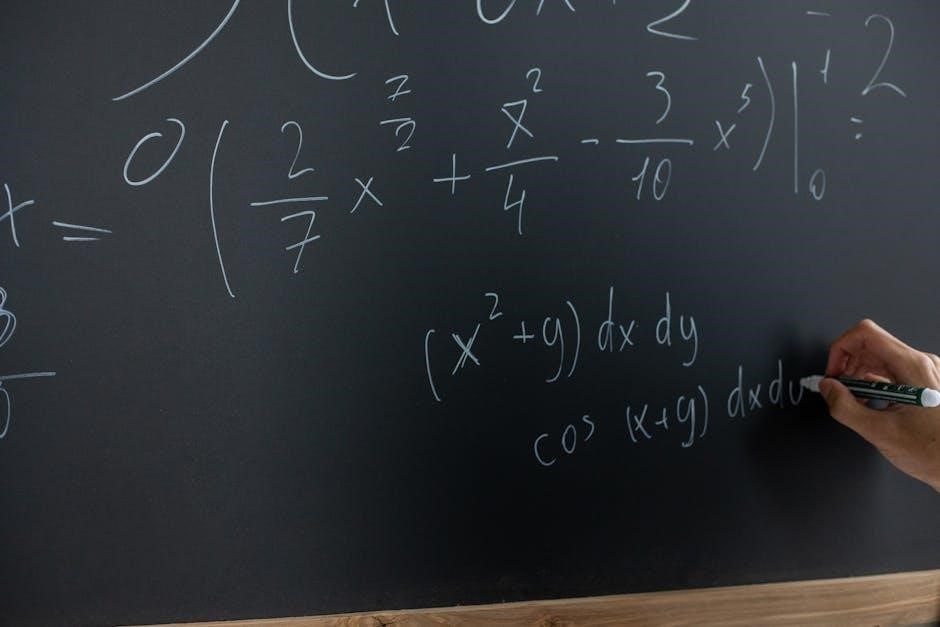
Mastering problem-solving skills builds confidence and prepares students for more complex mathematical challenges. These worksheets are designed to foster a deeper understanding of mathematical concepts and their practical applications.
Mental Math Worksheets — Grade 6

Year 6 Maths Worksheets focusing on mental math are invaluable for building fluency and speed in calculations. These resources encourage students to perform arithmetic operations without relying on written methods, strengthening their number sense and recall skills. Regular practice with these worksheets significantly improves overall mathematical agility.

The worksheets typically include a range of exercises, such as quick addition and subtraction problems, multiplication and division facts, and calculations involving decimals and fractions. They are designed to be completed within a short timeframe, promoting quick thinking and efficient problem-solving.
Grade 6 mental math worksheets often incorporate varied formats, including missing number problems, number sequences, and estimation exercises. This variety keeps students engaged and challenges them to apply their skills in different ways.
Consistent use of these worksheets helps students develop a strong foundation in basic arithmetic, which is essential for success in more advanced mathematical topics. They are a fantastic tool for reinforcing learning and building confidence.
Homework Sheets & Curriculum Alignment
Year 6 Maths Worksheets designed as homework sheets provide valuable reinforcement of classroom learning. These resources are specifically crafted to align with the Year 6 National Curriculum, ensuring students practice the concepts taught in school. A practical learning tool often includes double-sided sheets covering a broad spectrum of topics.
Effective homework worksheets offer a structured approach to independent practice, allowing students to consolidate their understanding and identify areas where they may need further support. They also encourage responsibility and time management skills.
Curriculum alignment is crucial; worksheets should directly address the learning objectives for Year 6 maths, including number work, geometry, measurement, and statistics. This ensures that homework is purposeful and contributes to overall progress.
Many worksheet sets recommend one sheet per homework assignment, providing a manageable workload. These resources are designed to be accessible and engaging, fostering a positive attitude towards maths practice outside of the classroom.
Formative Assessments for Year 6 Maths
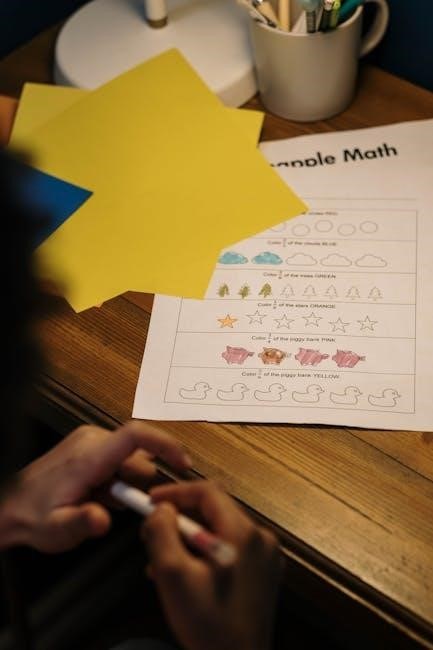
Year 6 Maths Worksheets are invaluable tools for formative assessment, allowing teachers to monitor student understanding during the learning process. Unlike summative assessments, these worksheets provide ongoing feedback to adjust instruction and support individual needs.
A formative assessment document for mathematics class 6 demonstrates this application. Worksheets can be used to quickly gauge student grasp of specific concepts, such as fractions, decimals, or problem-solving strategies. Observing patterns in student responses reveals common misconceptions.

These assessments aren’t about assigning grades; they’re about identifying learning gaps. Teachers can then provide targeted interventions, small group instruction, or differentiated activities to address those gaps.
Worksheet-based assessments offer a low-stakes environment for students to practice and demonstrate their understanding. Regular use of these tools promotes a culture of continuous improvement and helps students take ownership of their learning. The data gathered informs teaching and ensures all students progress.
Where to Download Year 6 Maths Worksheets PDF
Finding high-quality Year 6 Maths Worksheets PDF resources is easier than ever. Numerous online platforms offer free downloads and comprehensive collections tailored to the Year 6 curriculum. Several websites aggregate free worksheets, providing samples covering a wide range of topics, from numbers up to 100 and beyond, to more complex concepts like algebraic expressions.
A quick online search reveals options for downloading worksheets focusing on specific skills, such as division, decimals, or data handling. Many educational websites specialize in printable resources, offering categorized worksheets for easy access.
Furthermore, some sites provide complete homework sheets aligned with the Year 6 National Curriculum, offering a practical learning tool with double-sided sheets covering various topics. These resources often include answer keys for convenient marking and self-assessment.
Remember to preview the worksheets to ensure they align with your specific teaching objectives and curriculum requirements. Explore different platforms to discover the best fit for your students’ needs.